The following traditional prayers, plus other important principles, are also available (below) in a convenient 3-fold format where everything fits on both sides of a single sheet of paper.
I have done this to create a simple means of study, and hope that you find it useful.
Please find the downloads links further below to get either PDF (Acrobat) or MDI format print-ready files.
All 28 Most Important Catholic Prayers & Principles in a single webpage
(plus, separately:)
The Ten Commandments
The Seven Sacraments
The Our Father
The Hail Mary
The Glory Be
The Sign of the Cross
Act of Contrition
Grace (before meals)
Entering a Church
Commandments (Modernised)
Virtues (Theological & Cardinal)
Sins Against The Holy Spirit
Spiritual Works of Mercy
Corporal Works of Mercy
7 Gifts of The Holy Spirit
12 Fruits of The Holy Spirit
Stations of The Cross
Confiteor
Apostles Creed
Nicene Creed
Stations of the Cross
Showing posts with label Prayers. Show all posts
Showing posts with label Prayers. Show all posts
Wednesday, September 30, 2020

Wednesday, January 3, 2018
The Angelus and The Regina Coeli
Angelus (or Regina Coeli): This is the very ancient Catholic custom that has us stop what we are doing to greet our Blessed Mother for a moment (6:00 a.m., noon, 6:00 p.m. daily), as any good child remembers his mother during the day, and to meditate on the Incarnation and Resurrection of our Lord, which give such meaning to our entire existence. The Regina Coeli is said during the Easter season. The Angelus is said during the rest of the year.
THE ANGELUS


V. The Angel of the Lord declared unto Mary,
R. And she conceived of the Holy Spirit.
Hail Mary …
V. Behold the handmaid of the Lord,
 R. Be it done unto me according to thy word.
Hail Mary …
V. And the Word was made Flesh,
R. And dwelt among us.
Hail Mary …
V. Pray for us, O Holy Mother of God,
R. That we may be made worthy of the promises of Christ.
V. Let us pray. Pour forth, we beseech Thee, O Lord, Thy grace into our hearts; that, we to whom the incarnation of Christ, Thy Son, was made known by the message of an angel, may by His passion and cross, be brought to the glory of His resurrection. Through the same Christ our Lord.
All. Amen.
THE REGINA COELI


Queen of Heaven rejoice, alleluia:
For He Whom you did merit to bear, alleluia,
Has risen as He said, alleluia.
Pray for us to God, alleluia.
Rejoice and be glad, O Virgin Mary, alleluia.
For the Lord has truly risen, alleluia.
Let us pray. O God, Who gave joy to the world through the resurrection of Thy Son, our Lord Jesus Christ, grant we beseech Thee, that through the intercession of the Virgin Mary, His mother, we may obtain the joys of everlasting life. Through the same Christ our Lord. Amen.
Tuesday, June 27, 2017
Letter to Diognetus
 |
The Christians in the world
"Christians are indistinguishable from other men either by nationality, language or customs. They do not inhabit separate cities of their own, or speak a strange dialect, or follow some outlandish way of life. Their teaching is not based upon reveries inspired by the curiosity of men. Unlike some other people, they champion no purely human doctrine. With regard to dress, food and manner of life in general, they follow the customs of whatever city they happen to be living in, whether it is Greek or foreign.
And yet there is something extraordinary about their lives. They live in their own countries as though they were only passing through. They play their full role as citizens, but labor under all the disabilities of aliens. Any country can be their homeland, but for them their homeland, wherever it may be, is a foreign country. Like others, they marry and have children, but they do not expose them. They share their meals, but not their wives.
They live in the flesh, but they are not governed by the desires of the flesh. They pass their days upon earth, but they are citizens of heaven. Obedient to the laws, they yet live on a level that transcends the law. Christians love all men, but all men persecute them. Condemned because they are not understood, they are put to death, but raised to life again. They live in poverty, but enrich many; they are totally destitute, but possess an abundance of everything. They suffer dishonor, but that is their glory. They are defamed, but vindicated. A blessing is their answer to abuse, deference their response to insult. For the good they do they receive the punishment of malefactors, but even then they, rejoice, as though receiving the gift of life. They are attacked by the Jews as aliens, they are persecuted by the Greeks, yet no one can explain the reason for this hatred.
To speak in general terms, we may say that the Christian is to the world what the soul is to the body. As the soul is present in every part of the body, while remaining distinct from it, so Christians are found in all the cities of the world, but cannot be identified with the world. As the visible body contains the invisible soul, so Christians are seen living in the world, but their religious life remains unseen. The body hates the soul and wars against it, not because of any injury the soul has done it, but because of the restriction the soul places on its pleasures. Similarly, the world hates the Christians, not because they have done it any wrong, but because they are opposed to its enjoyments.
Christians love those who hate them just as the soul loves the body and all its members despite the body's hatred. It is by the soul, enclosed within the body, that the body is held together, and similarly, it is by the Christians, detained in the world as in a prison, that the world is held together. The soul, though immortal, has a mortal dwelling place; and Christians also live for a time amidst perishable things, while awaiting the freedom from change and decay that will be theirs in heaven. As the soul benefits from the deprivation of food and drink, so Christians flourish under persecution. Such is the Christian’s lofty and divinely appointed function, from which he is not permitted to excuse himself."
From a letter to Diognetus (Nn. 5-6; Funk, 397-401)
Prayer
Father of all holiness,
guide our hearts to you. Keep in the light of your truth all those you have freed from the darkness of unbelief. We ask this through our Lord Jesus Christ, your Son, who lives and reigns with you and the Holy Spirit, one God, for ever and ever.
Prepared by the Spiritual Theology Department
of the Pontifical University of the Holy Cross
Fr. Michael, Byzantine? One of the speakers? Runs the podcast?
|
Monday, December 3, 2012
Prayer of St. Gertrude the Great
Prayer of
St. Gertrude the Great
"Eternal Father, I offer Thee the most Precious Blood of Jesus, with all the Masses being said all over the world this day, for the Souls in Purgatory."
Our Lord showed St. Gertrude a vast number of souls leaving Purgatory and going to Heaven as a result of this prayer, which the Saint was accustomed to say frequently during the day.
Taken from the booklet Read Me or Rue It by Fr. Paul O’Sullivan which has the approval of the Cardinal Patriarch of Lisbon, Portugal – March 4, 1936.
St. Gertrude's life was the mystic life of the Cloister – a Benedictine nun. She meditated on the Passion of Christ, which many times brought a flood of tears to her eyes. She did many penances and Our Lord appeared to her many times. She had a tender love for the Blessed Virgin and was very devoted to the suffering souls in Purgatory. She died in 1334. Her feast day is November 16th.
|
Thursday, March 17, 2011
St. Patrick Breat-Plate

According to the Catholic Encyclopedia: The beautiful prayer of St. Patrick, popularly known as "St. Patrick’s Breast-Plate," is supposed to have been composed by him in preparation for this victory over paganism. The following is a literal translation from the old Irish text . . .”
I bind to myself todayThe strong virtue of the Invocation of the Trinity:I believe the Trinity in the UnityThe Creator of the Universe.
I bind to myself todayThe virtue of the Incarnation of Christ with His Baptism,The virtue of His crucifixion with His burial,The virtue of His Resurrection with His Ascension,The virtue of His coming on the Judgment Day.
I bind to myself todayThe virtue of the love of seraphim,In the obedience of angels,In the hope of resurrection unto reward,In prayers of Patriarchs,In predictions of Prophets,In preaching of Apostles,In faith of Confessors,In purity of holy Virgins,In deeds of righteous men.
I bind to myself todayThe power of Heaven,The light of the sun,The brightness of the moon,The splendor of fire,
The flashing of lightning,The swiftness of wind,The depth of sea,The stability of earth,The compactness of rocks.
I bind to myself todayGod’s Power to guide me,God’s Might to uphold me,God’s Wisdom to teach me,God’s Eye to watch over me,God’s Ear to hear me,God’s Word to give me speech,God’s Hand to guide me,God’s Way to lie before me,God’s Shield to shelter me,God’s Host to secure me,Against the snares of demons,Against the seductions of vices,Against the lusts of nature,Against everyone who meditates injury to me,Whether far or near,Whether few or with many.
I invoke today all these virtuesAgainst every hostile merciless powerWhich may assail my body and my soul,Against the incantations of false prophets,Against the black laws of heathenism,Against the false laws of heresy,Against the deceits of idolatry,Against the spells of women, and smiths, and druids,Against every knowledge that binds the soul of man.
Christ, protect me todayAgainst every poison, against burning,Against drowning, against death-wound,That I may receive abundant reward.
Christ with me, Christ before me,Christ behind me, Christ within me,Christ beneath me, Christ above me,Christ at my right, Christ at my left,Christ in the fort,Christ in the chariot seat,Christ on the deck,Christ in the heart of everyone who thinks of me,Christ in the mouth of everyone who speaks to me,Christ in every eye that sees me,Christ in every ear that hears me.
I bind to myself todayThe strong virtue of an invocation of the Trinity,I believe the Trinity in the UnityThe Creator of the Universe.
Tuesday, March 15, 2011
Prayer of St. Ephraim the Syrian
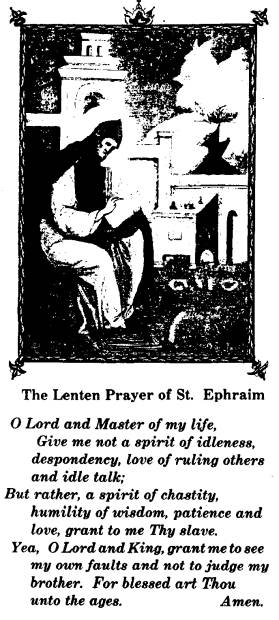
O Lord and Master of my life, give me not a spirit of sloth, vain curiosity, lust for power, and idle talk (great metanoia).
But give to me Thy servant a spirit of soberness, humility, patience, and love (great metanoia).
O Lord and King, grant me to see my own faults and not to condemn my brother (metanoia).
O Lord, be gracious to me, the sinner (twelve times, with a small metanoia after each).
O Lord and King, grant me to see my own faults and not to condemn my brother: for blessed art Thou to the ages of ages. Amen (metanoia).
There is a special, little known characteristic in the basic diataxis for the prayer of Saint Ephraim which appeals to me. The prayer is already quite unique in its simple, direct textual beauty.
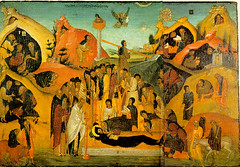
The prayer of Saint Ephraim the Syrian, an ascetic fourth-century church father, is unique in its combining of great and small metanoiai, or prostrations, with the text.
Texts reflecting on the prayer's beauty and power, as well as its place in the lenten services abound. There are, however, two specific aspects of its historical place in the liturgical life of the Eastern Orthodox Church which I would like to underline.
First, common knowledge has it that it is used only during the great Paschal fast. The preciseness of sinaitic typika, however, also call for the prayer and its metanoiai to be used at two other times: Mondays, Wednesdays and Fridays of the Nativity fast and fast of the Apostles'. Why Mondays, Wednesdays and Fridays? As you probably know, these are the fast days in monasteries. Therefore, the services on these days during the Nativity and Apostles fasts actually follow the lenten order of services! This is expressed via the use of Alleluia in the Orthros instead of the Apolytikion of the day. The Great Apodeipnon, or Compline, and Mid-Hour Services are also used on these days. But even this somewhat obscure detail is not the main point of what I share today.

This second aspect of the prayer's diataxis is, I think, the most potent. The strange thing is that you don't even need an ancient Typikon to find it; it's right there in the Horologion and Triodion books. While the above rubric of using the prayer in the Nativity and Apostles' fasts has mostly fallen out of use today, even in the Athonite monasteries, this second aspect has not. It is how the prayer is used both throughout Mount Athos and monasteries elsewhere, still closely following the ancient taxis.
This most powerful aspect of the use of the Prayer of Ephraim is indicated by the use of two words, either "mystikos" or "kath' heauton." In English these words can be translated as "mystically," or "to oneself." Simply put, the prayer and its metanoiai are called to be performed in silence.
The picture is quite powerful, if you can imagine a church full of monks all doing their prostrations and crosses in silence. All that is heard is the swoosh of their robes as they fall down and rise up again.
I think this is a most uniquely private moment in the mystical liturgical worship of the Eastern Church.
The prayer of Saint Ephraim the Syrian can be used as a centerpiece for the believer's personal prayer life during the fasts. Today's hectic life, zealous for our every waking moment is all too often the excuse for a weak or even non-existent prayer life from Sunday to Sunday for many. This is also a primary spiritual argument why many find it so hard to fast today. Without at least an attempt at living prayer true fasting is virtually impossible. The beloved saint of the twentieth century, Saint Nektarios the wonderworker and bishop of Pentapolis also connected fasting with the preparation for the mystery of holy Repentance, Confession. Isn't this the preparation for the great Pascha?
Therefore, whether one learns to make the prayer of Saint Ephraim out loud or in silence, the prayer of Saint Ephraim the Syrian, I have seen, can be a positive element in a parish's or individual's spiritual life. It warms hearts, enlivens prayer and brings us into Christ's presence in a profound, time-tested way.
This most powerful aspect of the use of the Prayer of Ephraim is indicated by the use of two words, either "mystikos" or "kath' heauton." In English these words can be translated as "mystically," or "to oneself." Simply put, the prayer and its metanoiai are called to be performed in silence.
The picture is quite powerful, if you can imagine a church full of monks all doing their prostrations and crosses in silence. All that is heard is the swoosh of their robes as they fall down and rise up again.
I think this is a most uniquely private moment in the mystical liturgical worship of the Eastern Church.
The prayer of Saint Ephraim the Syrian can be used as a centerpiece for the believer's personal prayer life during the fasts. Today's hectic life, zealous for our every waking moment is all too often the excuse for a weak or even non-existent prayer life from Sunday to Sunday for many. This is also a primary spiritual argument why many find it so hard to fast today. Without at least an attempt at living prayer true fasting is virtually impossible. The beloved saint of the twentieth century, Saint Nektarios the wonderworker and bishop of Pentapolis also connected fasting with the preparation for the mystery of holy Repentance, Confession. Isn't this the preparation for the great Pascha?
Therefore, whether one learns to make the prayer of Saint Ephraim out loud or in silence, the prayer of Saint Ephraim the Syrian, I have seen, can be a positive element in a parish's or individual's spiritual life. It warms hearts, enlivens prayer and brings us into Christ's presence in a profound, time-tested way.
 St. Ephraim was born early in the fourth century in the ancient city of Nisibis in Mesopotamia, where the Roman Empire bordered on the Persian Kingdem. At one time Mesopotamia belonged to Syria and for this reason St. Ephraim is known as "the Syrian." He was born of Christian parents before the Edict of Milan was issued (313), establishing official toleration of religion, and, as he later wrote, his ancestors "confessed Christ before the judge; I am related to martyrs."
 When he was still a baby, his parents had a prophetic dream: from the boy's tongue sprang a lush vine which produced abundant clusters of grapes. The more the birds ate the fruit, the more it multiplied. Later it was revealed that these clusters were his sermons, the leaves of the vine--his hymns.
| Remember not O Lord the sins of my youth. (Ps. 25:7) |
Judging from his youth, however, one could never have guessed his future greatness. In spite of his parents' having educated him in Christian precepts, he was impetuous and even rather wild, like an unruly colt which resists the bridle: "I would quarrel over trifles, acted foolishly, gave in to bad impulses and lustful thoughts .... My youth nearly convinced me that life is ruled by chance. But God's Providence brought my impassioned youth to the light of wisdom." He relates the story of his conversion:
"One day my parents sent me outer town and I found a pregnant cow feeding along the road. I took up stones and began pelting the cow, driving it into the woods till evening when it fell down dead? During the night it was eaten by wild beasts. On my way back, I met the poor owner of the cow. 'My son,' he asked, 'did you drive away my cow?' I not only denied it, but heaped abuse and insult upon the poor man."
A few days later he was idling with some shepherds. When it grew too late to return home, he spent the night with them. That night some sheep were stolen and the boy was accused of being in league with the robbers. He was taken before the magistrate and cast into prison. In a dream an angel appeared to Ephraim and asked him why he was there. The boy began at once to declare that he was, innocent. "Yes," said the angel, "you are innocent of the crime imputed to you, but have you forgotten the poor man's cow?"
When Ephraim saw the tortures to which criminals were subjected, he became terrified. He turned to God and vowed that he would become a monk if God would spare him such a cruel ordeal. The magistrate, however, just laughed at the youth's tears and ordered that he be stretched on the rack.
 But just then a servant came to announce that dinner was ready. "Very well," said the magistrate, "I will examine the boy another day." And he ordered him back to prison.
 Providentially, the next time the magistrate saw Ephraim, he thought he had been punished enough and dismissed him. Although he was spared the rack, Ephraim had learned his lesson and, like the Prophet David, he entreated the Lord to overlook his youthful folly. True to his vow, upon his release he went straightway to the hermits living in the mountains where he became a disciple of St. James (Jan. 12), who later became a great bishop of Nisibis.
Born again in repentance, Ephraim began to train as an athelete of virtues, exorcizing himself in the study of the Holy Scriptures and in prayer and fasting. The passionate and wayward youth was transformed into a humble and contrite monk, weeping day and night for his sins and entirely surrendered to God. Ephraim's earnest resolve pleased the Lord Who rewarded him with the gifts of wisdom; grace flowed from his mouth like a sweet stream, in fulfillment of his parents' dream.
St. James recognized his disciple's God given talents, and as a bishop he entrusted Ephraim with preaching the Word of God and instructing children in school. In 325 he took Ephraim with him to the First Ecumenical Council in Nicea. Returning to Nisibis, Ephraim continued with his missionary work until 363 when the Persians conquered the city and most of its Christian inhabitants departed.
Ephraim decided to go to the city of Edessa around which monastic life was flourishing. He prayed that there the Lord would send to meet him a man who could converse with him on the Holy Scriptures for his spiritual profit. Upon entering the city gates, he was met by a woman. Disappointed, he turned mentally to God: "Lord, Thou hast disregarded Thy servant's prayer. For how can she converse with me on Biblical wisdom?" The woman only stared at him. "Why, O woman, are you standing there staring at me?"asked the Saint. "I am looking at you," she replied, "because woman is taken from man, but you should look not at me but at the earth from which you were taken." Ephraim was astonished at the woman' s reply and gave thanks to God Who had answered his prayer in granting him this soul-profiting lesson.
In Edessa, Ephraim earned a humble living in the service of a bath keeper. He used his free time in preaching the Word of God to the unbelievers. Angered' by Ephraim's successes, the devil set his traps to catch the servant of God. Once, for example, as the Saint was preparing his dinner, a woman gazing from the window of an adjacent dwelling conceived a desire to seduce him. "Bless me, sir," she shouted at him. "The Lord bless you," replied the Saint. "What do you · need for your food?" she continued. Discerning the true purpose of her conversation, Ephraim answered, "Three stones and some sand to block up your window." "I want to lie with you," said the woman shamelessly, "but you are refusing from the first word." "In that case ," replied Ephraim, "you cannot do so in any other place than the middle of the city." "Shall we not be ashamed of the people?'' asked the harlot, surprised. "if we are ashamed of men ," the Saint replied, "how much more ought we to be ashamed of, and also to fear God Who knows all the secrets of men! For He will judge the whole world and will reward everyone according to his deeds." By God's grace his words moved the harlot to repentance and she begged him to guide her to the path of salvation. Having received from him basic instruction in the Christian Faith, she entered a convent.
After living for some time in Edessa, the Saint was advised by a holy elder to go into the wilderness. He settled in a cave of the nearby "Mount of Edessa," where he gave himself up to prayer, fasting and the study of Holy Scripture. There occurred an incident which illustrates the Saint's dispassion. Once, after a long fast, his disciple was bringing him a meal, when the dish of food fell and broke. Seeing the brother's shame and consternation, the Saint said simply: "Never mind, if the food will not come to us, we shall go to the food." He sat down on the ground by the broken dish and proceeded to eat the meal as well as he could. It was said of him that although he was naturally prone to passion, he never exhibited angry feelings towards anyone from the time of his embracing the 'monastic life.
St. Ephraim once had a revelation regarding St. Basil the Great. He saw in a vision a pillar of fire reaching to heaven, and he heard a voice: "Ephraim, Ephraim! Such as you see this pillar of fire, so, too, is Basil!"
The vision inspired Ephraim with the desire to see this great Teacher of the Church, and, taking with him an interpreter (for he spoke no Greek), he journeyed to Caesarea in Cappadocia. There the holy hierarch greeted the desert-dweller with a corresponding enthusiasm and admiration: "I now see that what I heard about you is true. . . It is written in the Prophet David: Ephraim is the strength of my head (Ps. 59:9). These prophetic words refer truly to you, for you have led many to [he way of virtue and strengthened them in it. And your meekness and dispassion of heart shin e for all, like the light."
Then Basil the Great asked:
"Why, venerable father, do you not receive consecration to the order of priesthood, as befits you?"
"Because I am a sinner, my lord!" answered Ephraim through the interpreter.
"O, if only I had your sins!" said Basil, and added: "Let us make a prostration to the ground."
But when they were bowed to the ground, St. Basil laid his hand on St. Ephraim's head and recited the prayer of consecration to the diaconate. That is how St. Ephraim was made a deacon. He was at that time about sixty years old.
It was the Saint's desire to continue in the heremitic life, hut such was his talent as a preacher that the Lord would not have his light hidden under a bushel. Obedient to the Lord's will as revealed to him by an angel, Ephraim returned to Edessa where he began again to instruct people in the Faith. There he also established a college which later produced many faro ou s teachers of the Syrian Church.
When the heretic Apollinaris was creating havoc in the Church with his erroneous teaching concerning the nature of Christ at His Incarnation, St. Ephraim tricked Apoiiinaris' servant into lending him the two books in which these teachings were set forth. After gluing all the pages together, he returned the books to the unsuspecting servant and then challenged Apollinaris to a public debate. When Apollinaris Found himself unable to open his books to quote from them, he became thoroughly confused and retired in shame. His heresy soon died out.
Not only was St. Ephraim en eloquent and powerful teacher, he was also a prolific writer. Although he lacked a formal education, he comprehended with ease the most abstruse problems of philosophy, and his commentaries On the Old Testament books of Moses impressed even the most scholarly men of Ms time. But if his writings spoke to the mind, they were more greatly to be praised for the effect they had on the soul. As St. Gregory of Nyssa writes:
“Who that is proud would not become the humblest of men, reading his discourse on humility? Who would not be influenced with a divine fire, reading his discourse on charity? Who would not wish to be chaste in heart and soul by reading the praise he has lavished on virginity? Who would not be frightened by hearing his discourse on the Last Judgment, which he has depicted so vividly that nothing can be added to it?"
In spite of the gifts which God so lavishly bestowed upon him, St. Ephraim remained deeply humble. He even feigned madness so as to avoid being consecrated bishop and the glory that attends that position. Doubtless, his humility was guarded by the remembrance of the sins of his youth and by his contrite spirit which followed upon this remembrance. But while tears of repentance constantly flowed from his eyes, Ephraim's face was bright and shone with joy. As St. Gregory writes: "Where Ephraim speaks of contrition, he lifts our thought to the Divine goodness and pours cut thanksgiving and praise to the Most High."
On January 28, 373, after a brief illness, St. Ephraim reposed from his labors and was received into the heavenly habitations. The citizens of Edessa called him a "lyre of the Holy Spirit." Now, centuries later, his works still sing to the soul, inspiring it with the sweet fruit of repentance.
Tuesday, December 28, 2010
A Franciscan Christmas Blessing for Justice and Peace
May God bless you with discomfort…
at easy answers, hard hearts,
half-truths, and superficial relationships.
May God bless you
so that you may live from deep within your heart
where God’s Spirit dwells.
May God bless you with anger…
at injustice, oppression,
and exploitation of people.
May God bless you so that you may
work for justice, freedom, and peace.
May God bless you with tears…
to shed for those who suffer from pain,
rejection, starvation and war.
May God bless you so that you
may reach out your hand
to comfort them and turn their pain into joy.
And may God bless you with
enough foolishness
to believe that you can make a difference
in this world, in your neighborhood,
so that you will courageously try
what you don’t think you can do, but,
in Jesus Christ you’ll have all the strength necessary.
May God bless you to fearlessly
speak out about injustice,
unjust laws, corrupt politicians,
unjust and cruel treatment of prisoners,
and senseless wars,
genocides, starvations, and poverty that is so pervasive.
May God bless you that you remember
we are all called
to continue God’s redemptive work
of love and healing
in God’s place, in and through God’s name,
in God’s Spirit, continually creating
and breathing new life and grace
into everything and everyone we touch.
Source: “Troubadour: A Missionary Magazine,”
published by the Franciscan Missionary Society, Liverpool, UK: Spring 2005
Found @ Vox Nova - A Franciscan Christmas Blessing for Justice and Peace
at easy answers, hard hearts,
half-truths, and superficial relationships.
May God bless you
so that you may live from deep within your heart
where God’s Spirit dwells.
May God bless you with anger…
at injustice, oppression,
and exploitation of people.
May God bless you so that you may
work for justice, freedom, and peace.
May God bless you with tears…
to shed for those who suffer from pain,
rejection, starvation and war.
May God bless you so that you
may reach out your hand
to comfort them and turn their pain into joy.
And may God bless you with
enough foolishness
to believe that you can make a difference
in this world, in your neighborhood,
so that you will courageously try
what you don’t think you can do, but,
in Jesus Christ you’ll have all the strength necessary.
May God bless you to fearlessly
speak out about injustice,
unjust laws, corrupt politicians,
unjust and cruel treatment of prisoners,
and senseless wars,
genocides, starvations, and poverty that is so pervasive.
May God bless you that you remember
we are all called
to continue God’s redemptive work
of love and healing
in God’s place, in and through God’s name,
in God’s Spirit, continually creating
and breathing new life and grace
into everything and everyone we touch.
Source: “Troubadour: A Missionary Magazine,”
published by the Franciscan Missionary Society, Liverpool, UK: Spring 2005
Found @ Vox Nova - A Franciscan Christmas Blessing for Justice and Peace
Sunday, December 26, 2010
The Angelus
V: The Angel of the Lord declared unto Mary
R: And she conceived by the Holy Ghost.
at the hour of our death. Amen.
All: Pour forth, we beseech thee, O Lord, thy grace unto our hearts, that we, to whom the Incarnation of Christ, thy Son, was made known by the message of an Angel, may by His Passion and Cross be brought to the glory of His Resurrection, through the same Christ, our Lord, Amen.
Blessing before meals: Bless us, O Lord, and these thy gifts, which we are about to receive from thy bounty, through Christ, our Lord we give Thee our thanks. Amen.
R: And she conceived by the Holy Ghost.
V: Hail Mary, full of grace: The Lord is with thee. Blessed art thou among women and blessed is the fruit of thy womb, Jesus.
R: Holy Mary, Mother of God: Pray for us sinners now and at the hour of our death. Amen.
V: Behold, the handmaid of the Lord.
R: Be it done unto me according to thy word. V: Hail Mary ...
R: Holy Mary ... V: And the Word was made flesh
R: And dwelt among us. V: Hail Mary ...
R: Holy Mary ... V: Pray for us, O holy Mother of God,
R: That we may be made worthy of the promises of Christ. V: Let us pray.
Blessing before meals: Bless us, O Lord, and these thy gifts, which we are about to receive from thy bounty, through Christ, our Lord we give Thee our thanks. Amen.
[Madonna and Child - Watercolor by Alice Mankowski]
Thursday, September 30, 2010
Guigo II, Selections from The Ladder of Monks
 | THE LADDER of MONKS by Guigo II (1140-1193) Epistola de Vita Contemplativa (Scala Claustralium) A Carthusian enters the Grand Chartreuse, The Belles Heures of John Duke of Berry, 1408 fol 97. |
tr. L. Dysinger, based on tr. by J. Walsh and E. Colledge, (Image, N.Y., 1978) pp. 81-89
Latin text in S.C. 163 (Paris, 1970) pp. 82-123
Latin text in S.C. 163 (Paris, 1970) pp. 82-123
II. CONCERNING the FOUR RUNGS [of the Ladder] | II DE QUATUOR GRADIBUS |
ONE DAY while I was occupied with manual labor | Cum die quadam corporali manuum labore occupatus |
I began to reflect on man’s spiritual work, | de spiritali hominis exercitio cogitare coepissem, |
and suddenly four steps for the soul came into my reflection: | quatuor spiritales gradus animo cogitanti se subito obtulerunt |
reading, meditation, prayer, [and] contemplation | lectio scilicet meditatio, oratio contemplatio |
THIS is a ladder for monks (lit.“the cloistered”) Haec est scala claustralium by means of which they are raised up from earth to heaven qua de terra in coelum sublevantur, It has [only a] few separate rungs, yet its length is immense and incredible: gradibus quidem distincta paucis, immensae tamen et incredibilis magnitudinis, | 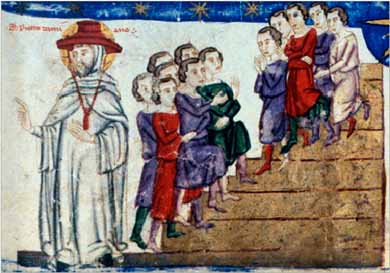 The Divine Comedy, Paradiso, “Peter Damien at the ladder of heaven” Oxford, Bodl. MS.Holkh. misc.48, p.139 |
for its lower part stands on the earth, | cujus extrema pars terrae innixa est, |
while its higher [part] pierces the clouds and touches the secrets of heaven. | superior vero nubes penetrat et coelorum secreta rimatur |
JUST as its rungs have various names and numbers, | Hi gradus sicut nominibus et numero sunt diversi |
so also so they differ in order and merit; | ita ordine et merito sunt distincti; |
| and if one diligently searches out their properties and functions | quorum proprietates et officia, |
- what each [rung] does in relation to us, how they differ from one another and how they are ranked- | quid singuli circa nos efficiant, quomodo inter se differant et praeemineant, si quis diligenter inspiciat, |
he will regard whatever labor and study he expends as brief and simple compared with the great usefulness and sweetness [he gains]. | quidquid laboris et studii impenderit in eis breve reputabit et facile prae utilitatis et dulcedinis magnitudine. |
Reading is careful study of [Sacred] Scripture, | Est autem lectio sedula scriptuaru |
with the soul’s [whole] attention: | cum animi intentione inspectio. |
Meditation is the studious action of the mind | Meditatio est studiosa mentis actio, |
to investigate hidden truth, led by one’s own reason. | occultae veritatis notitiam ductu propriae rationis investigans. |
Prayer is the heart’s devoted attending to God, | Oratio est devota cordis in Deum intentio |
so that evil may be removed | pro malis removendis |
and good may be obtained. | vel bonis adipiscendis. |
Contemplation is the mind suspended -somehow elevated above itself - in God | Contemplatio est mentis in Deum suspensae quaedam supra se elevatio |
so that it tastes the joys of everlasting sweetness. | eternae dulcedinis gaudia degustans |
HAVING assigned descriptions to each of the four rungs, | Assignatus ergo quatuor graduum descriptionibus, |
we must see what their functions are in relation to us. | restat ut eorum circa nos officia videamus. |
III THE FUNCTIONS of THESE AFOREMENTIONED RUNGS | III QUAE SUNT OFFICIA PRAEDICTORUM GRADUUM |
FOR the sweetness of a blessed life: | Beatae vitae dulcedinem |
Reading seeks; | lectio inquirit, |
meditation finds; | meditatio invenit, |
prayer asks; | oratio postulat, |
contemplation tastes. | contemplatio degustat |
Reading, so to speak, puts food solid in the mouth, | Lectio quasi solidum cibum ori apponit, |
meditation chews and breaks it, | meditatio masticat et frangit |
prayer attains its savor, | oratio saporem acquirit, |
contemplation is itself the sweetness that rejoices and refreshes. | contemplatio est ipsa dulcedo quae jocundat et reficit. |
Reading concerns the surface, | Lectio in cortice, |
meditation concerns the depth | meditatio in adipe, |
prayer concerns request for what is desired, | oratio in desiderii postulatione, |
contemplation concerns delight in discovered sweetness. | contemplatio in adeptae dulcedinis delectatione. |
IX HOW GRACE is HIDDEN IX DE GRATIAE OCCULTATIONE | 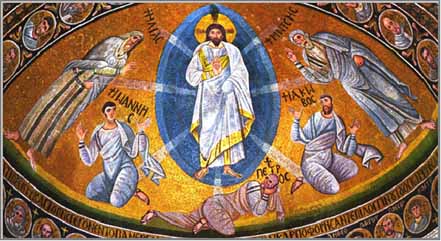 |
O MY soul, too long have we prolonged this speech. Yet it was good for us to be here, and with Peter and John to contemplate the glory of the spouse; and to abide for a time with Him, had He wished us to make here not two, not three tabernacles, but one in which we might dwell together, and together be filled with joy. | O anima, diu protraximus sermonem istum. Bonum enim erat nos hic esse et cum Petro et cum Johanne contemplari gloriam sponsi et diu manere cum illo, si vellet hic fieri non duo, non tria tabernacula, sed unum in quo simul essemus, simul delectaremur. |
| BUT now the spouse says, “Let me go, for dawn is now arising,” now you have received the light of grace and the visitation which you desired. Sed jam, dicit sponsus, dimitte me, jam enim ascendit aurora, jam lumen gratiae et visitationem quam desiderabas accepisti. |  |
HE thus gives his blessing, He withers the nerve of the thigh, He changes the name of Jacob to Israel; and then for a brief time He withdraws, this spouse so long desired, so quickly gone. Data ergo benedictione et mortificato nervo femorum et mutato nomine de Jacob in Israel, paulisper secedit sponsus diu desideratus, cito elapsus. |  Jacob Wrestles with the Angel, 12th c. illum MS |
HE removes himself, thus ending, too, [our] visitation, and the sweetness of contemplation; | Subtrahit se quantum ad praedictam visitationem, quantum ad contemplationis dulcedinem; |
but yet His presence abides [with us]: thus guiding [us]; thus giving [us] grace; thus uniting [us to Himself]. | manet tamen praesens quantum ad gubernationem, quantum ad gratiam, quantum ad unionem. |
XII RECAPITULATION | XII RECAPITULATIO PRAEDICTORUM |
IN order to focus more clearly what we have already said at length, we will gather it into a summary. In what was said above it has been shown through examples how these three rungs interrelate with each other, and how they precede one another another in both the orders of time and causality. | Ut ergo quae diffusius dicta sunt simul juncta melius videantur, praedictorum summam recapitulando colligamus. Sicut in praemissis praenotatum est exemplis, videre potes quomodo praedicti gradus sibi invicem cohaereant; et sicut temporaliter, ita est causaliter se praecedant. |
Reading, like a foundation, comes first: and by giving us the matter for meditation, it sends us on to meditation. | Lectio est enim quasi fundamentum prima occurrit, et data materia mittit nos ad meditationem. |
Meditation diligently investigates what is to be sought; it digs, so to speak, for treasure which it [then] finds and exposes: but since it is of itself powerless to obtain it, it sends us on to prayer. | Meditatio quid appetendum sit diligentius inquirit, et quasi effodiens thesaurum invenit et ostendit; sed cum per se obtenere non valeat, mittit nos ad orationem. |
Prayer, lifting itself with its whole strength to God, pleads for the desired treasure - the sweetness of contemplation. | Oratio se totis viribus ad Deum erigens, impetrat thesaurum desiderabilem, contemplationis suavitatem. |
[Contemplation’s] advent rewards the labors of the other three; it inebriates the thirsty soul with the sweetness of heavenly dew. | Haec adveniens praedictorum trium laborem remunerat, dum coelestis rore dulcedinis animam sitientem inebriat. |
Reading accords with exercise of the outward [senses]; meditation accords with interior understanding; prayer accords with desire; contemplation is above all senses. | Lectio est secundum exterius exercitium, meditatio secundum interiorem intellectum, oratio secundum desiderium, contemplatio supra omnem sensum. |
The first degree pertains to beginners, The second to the proficient, the third to devotees, the fourth to the blessed. | Primus gradus est incipientium, secundus proficientium, tertius devotorum, quartus beatorum. |
see also: Catholic Notebook
This Webpage was created for a workshop held at Saint Andrew's Abbey, Valyermo, California in 1998
Subscribe to:
Posts (Atom)