Showing posts with label 1500s. Show all posts

Wednesday, October 11, 2017

St. Ignatius of Loyola - Feast Day July 31

Feast Day: July 31 

Born: 1491 :: Died: 1556

This famous saint who started the Society of Jesus (Jesuits) was born in Guipuzcoa in Spain as Inigo Lopez de Loyola. He was from a rich Spanish family and was one of twelve children. As a boy, he was sent to be a page at the royal court of King Ferdinand and Queen Isabella. There he wished someday to become a great soldier and marry a beautiful lady.

In the battle of Pamplona, he did, indeed, win honor for his courage but, a wound in the leg from a cannon ball forced him to spend months in bed at Loyola Castle. Ignatius asked for some books to read. He preferred stories of knights, but only life stories of Jesus and the saints were available.

Having nothing else to do, he read them. A little by little, the books began attracting him. His life began to change.
He said to himself: "These were men and women like me, so why can't I do what they have done?" 
All the glory he had wanted before seemed worthless now. He began to imitate the saints in their prayers, penances and good works.

When he was fully recovered, Ignatius hung his sword before the altar of the Virgin Mary and put on simple robes and began to live a simple life. He then traveled Europe and went on a pilgrimage to the Holy Land before he settled in Rome.

St. Ignatius had to suffer many temptations and much shame. Before he could begin his great work of starting the Society of Jesus, he had to go back to school. He had to study Latin grammar. The rest of the students were little boys and Ignatius was thirty-three years old. Yet Ignatius was ready to bear the shame and went to the class because he knew he would need this knowledge to help him in his work for Jesus.

He received the boys' jeers and taunts with patience and good humor. He used his time trying to teach and
encourage people to pray. He was even put in jail for a while because of this! But that was not going to stop Ignatius.
"The whole city does not contain as many chains as I desire to wear for love of Jesus," he said.
Ignatius was forty-three years old when he graduated from the University of Paris. After this, with six other students, he took his religious vows and became a priest. Ignatius and his friends, including Blessed Peter Faber and Saint Francis Xavier promised to work for God in whatever way the Holy Father thought best. In 1540 their order was officially recognized by the pope.

Before Ignatius died, there were one thousand members of the Society of Jesus or "Jesuits." They were doing much good work teaching and preaching. He died in Rome, on July 31, 1556.

The Jesuits today have over five hundred universities and colleges; thirty thousand members; and teach over twenty thousand students each year.

Reflection: Let us pray today in the words of St. Ignatius Loyola: "Give me only your love and your grace. With this I am rich enough, and I have no more to ask."

Friday, June 24, 2011

St Thomas More in Five Easy Points

Saint Thomas More -- Feast Day June 22

Thomas More (February 7, 1478 – July 6, 1535) in five easy points:
  1. Sir Thomas More was an English lawyer, philosopher, author,   "Renaissance man", and Lord Chancellor to King Henry VIII.
  2. More was an ardent opponent of Protestantism and directed his attention against the heresies of Martin Luther and William Tyndale.
  3. St Thomas More wrote the political treatise Utopia in 1516. "Outopia" is Greek for "Nowhere."
  4. As chancellor of England, he silently opposed King Henry VIII's Act of Supremacy which placed the king as "head" of the Church of England. More was imprisoned in the Tower of London until he was convicted of "treason" and martyred by decapitation in 1535.
  5. Thomas More was beatified in 1886. He was canonized with John Fisher as a Catholic saint in 1935.
Recommended Movie, Man for All Seasons about St Thomas More
Source: http://cantuar.blogspot.com/2011/06/st-thomas-more-in-five-easy-points.html

Tuesday, December 21, 2010

Saint Peter Canisius 1521-1597 (Dec 21) Secret Agent for the Vatican

St. Peter Canisius
Feastday: December 21
b: 1521 d: 1597


In 1565, the Vatican was looking for a secret agent. It was shortly after the Council of Trent and the pope wanted to get the decrees of the Council to all the European bishops. What would be a simple errand in our day, was a dangerous assignment in the sixteenth century. The first envoy who tried to carry the decrees through territory of hostile Protestants and vicious thieves was robbed of the precious documents. Rome needed someone courageous but also someone above suspicion. They chose Peter Canisius. At 43 he was a well-known Jesuit who had founded colleges that even Protestants respected. They gave him a cover as official "visitor" of Jesuit foundations. But Peter couldn't hide the decrees like our modern fictional spies with their microfilmed messages in collar buttons or cans of shaving cream. Peter traveled from Rome and crisscrossed Germany successfully loaded down with the Tridentine tomes -- 250 pages each -- not to mention the three sacks of books he took along for his own university!

Why did the Vatican choose Peter Canisius for this delicate task?

Born in Holland in 1521, Peter had edited and written several volumes on Church history and theology, been a delegate to the Council of Trent, and reformed the German universities from heresy. Called to Vienna to reform their university, he couldn't win the people with preaching or fancy words spoken in his German accent. He won their hearts by ministering to the sick and dying during a plague. The people, the king, and the pope all wanted to make Peter bishop of Vienna, but Peter declined vigorously and administered the diocese for a year.

For many years during the Reformation, Peter saw the students in his universities swayed by the flashy speeches and the well-written arguments of the Protestants. Peter was not alone in wishing for a Catholic catechism that would present true Catholic beliefs undistorted by fanatics. Finally King Ferdinand himself ordered Peter and his companions to write a catechism. This hot potato got tossed from person to person until Peter and his friend Lejay were assigned to write it. Lejay was obviously the logical choice, being a better writer than Peter. So Peter relaxed and sat back to offer any help he could. When Father Lejay died, King Ferdinand would wait no longer. Peter said of writing: "I have never learned to be elegant as a writer, but I cannot remain dumb on that account." The first issue of the Catechism appeared in 1555 and was an immediate success. Peter approached Christian doctrine in two parts: wisdom -- including faith, hope, and charity -- and justice -- avoiding evil and doing good, linked by a section on sacraments.

Because of the success and the need, Peter quickly produced two more versions: a Shorter Catechism for middle school students which concentrated on helping this age group choose good over evil by concentrating on a different virtue each day of the week; and a Shortest Catechism for young children which included prayers for morning and evening, for mealtimes, and so forth to get them used to praying.

As intent as Peter was on keeping people true to the Catholic faith, he followed the Jesuit policy that harsh words should not be used, that those listening would see an example of charity in the way Catholics acted and preached. However, his companions were not always as willing. He showed great patience and insight with one man, Father Couvillon. Couvillon was so sharp and hostile that he was alienating his companions and students. Anyone who confronted him became the subject of abuse. It became obvious that Couvillon suffered from emotional illness. But Peter did not let that knowledge blind him to the fact that Couvillon was still a brilliant and talented man. Instead of asking Couvillon to resign he begged him to stay on as a teacher and then appointed him as his secretary. Peter thought that Couvillon needed to worry less about himself and pray more and work harder. He didn't coddle him but gave Couvillon blunt advice about his pride. Coming from Peter this seemed to help Couvillon. Peter consulted Couvillon often on business of the Province and asked him to translate Jesuit letters from India. Thanks to Peter , even though Couvillon continued to suffer depression for years, he also accomplished much good.

Peter died in December 21, 1597. He is known as the Second Apostle of Germany and was named a Doctor of the Church.

In His Footsteps
Peter believed in the importance in learning and understanding the Catholic faith. If it is available to you, resolve to read a portion of the new Catechism of the Catholic Church. Don't try to read too much but consider reading a page a day. Before we can spread our faith we must have a solid foundation in ourselves.

Prayer:
Saint Peter Canisius, you saw the good in even the most troublesome of people. You found their talents and used them. Help me to see beyond the behavior of others that may bother me to the gifts God has given them. Amen

SOURCE: http://abitadeacon.blogspot.com/

Friday, December 3, 2010

St. Francis Xavier Would NOT Be Very Popular Today

December 3 -- St. Francis Xavier

St. Francis Xavier was born in Navarre in 1506 and died near the coast of China in 1552.  He, along with St. Ignatius Loyola and six others made the famous vow of Montmartre in 1534. The Society of Jesus was born.
File:Stain glass window of St Francis of Xavier in Béthanie.JPG
St. Francis did missions in Paris, Venice, Rome and Lisbon before being appointed by John III, King of Portugal, to evangelize the people of the East Indies.  The long and dangerous voyage to India ended in Goa.  He spent the first five months preaching to the sick and catechizing children.
During this time, St. Francis saw that his fellow Catholics were subverting the Faith by their bad example.


He sent the King a dire warning: Do your duty to God and your subjects by insuring that your orders are carried out. Punish those who do not fulfill their obligations.  Otherwise, expect God judgment and the loss of souls.  St. Francis was not PC.

In 1542, St. Francis made many trips to the southern coast and even to Ceylon.  Christianity had been preached here but fervor was waning because of a lack of priests, cruel persecutions and the bad example of Portuguese soldiers.

For three hard years, St. Francis labored and reaped an abundant harvest.  Then he went to Malacca, the Moluccas and Mindanao, an island near the Philippines and back to Malacca, all within two years.
And he did all this traveling by ship, cart or on foot.  No jet planes.  How?  By his zeal and God’s grace!

In Malacca, St. Francis met a Japanese who aroused his desire to bring Christ to Japan. Within two years, St. Francis landed in Kagoshima, Japan.  He spent the next two year and a half years studying Japanese and converting many souls.

Two trusted clergymen assumed the Japanese missions enabling St. Francis to return to Goa where now his new venture was conquering China for Christ. Within sight of the mainland of China on a small island, St. Francis breathed his last.  His incredible apostolate lasted ten short years.
Many nations and vast seas did not daunt his zeal.  God rewarded St. Francis by allowing him to perform stupendous miracles and to convert tens of thousands of souls. He has been called the greatest missionary since the Apostles.

Today, many Catholics have become PC. We must ask for zeal and courage to go against the grain. To love souls enough to risk being pushed aside for telling the Truth. This is hard, but if we pray to Our Lady, she will help us. She will give us the right words and approach.  The salvation of a soul could be at stake. And it may be our own.

(Photo taken in Béthanie, Hong Kong, by Isaac Wong)
SOURCE: America Needs Fatima

Thursday, November 4, 2010

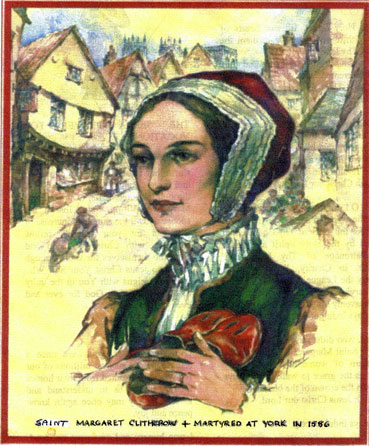
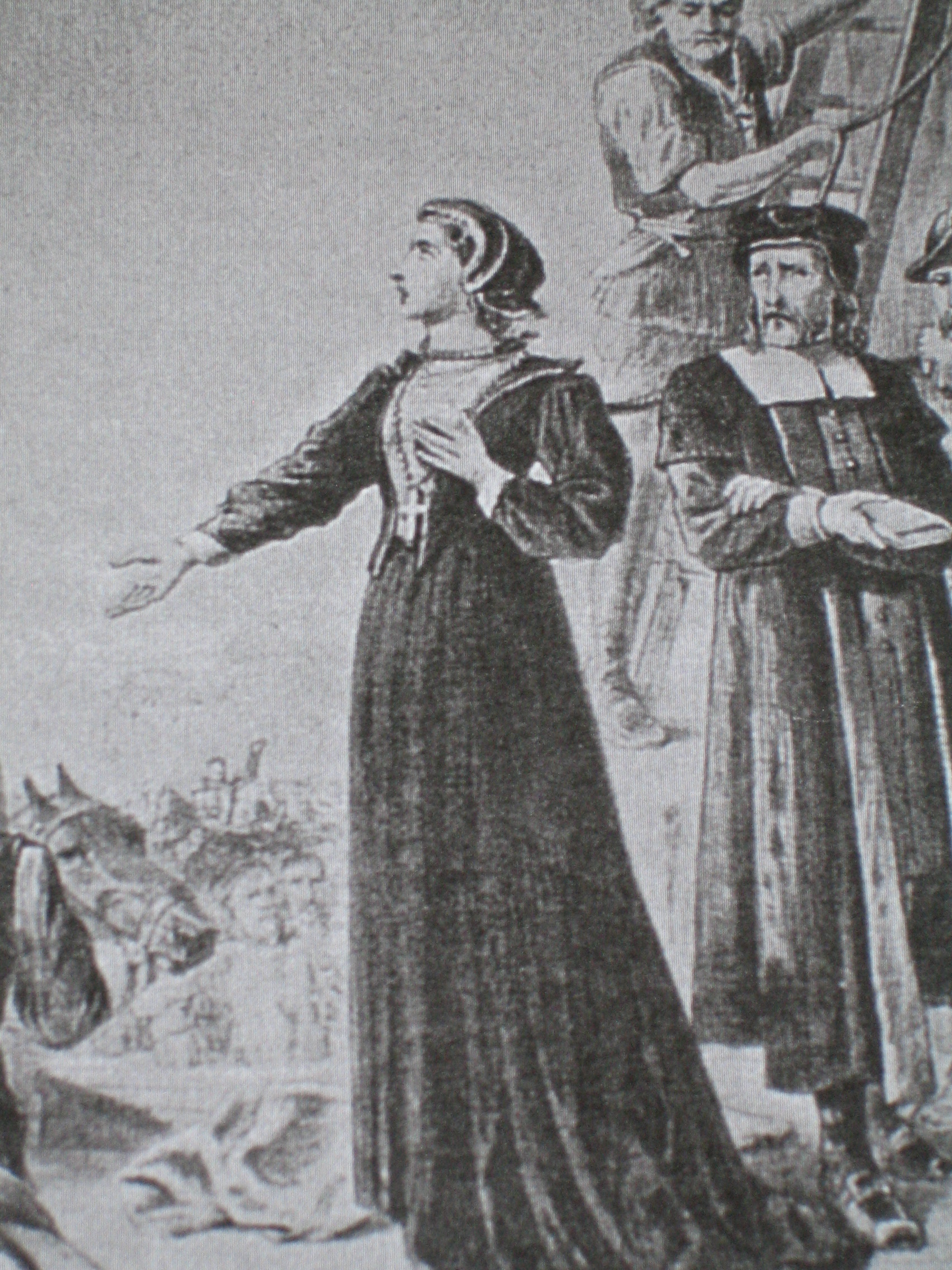
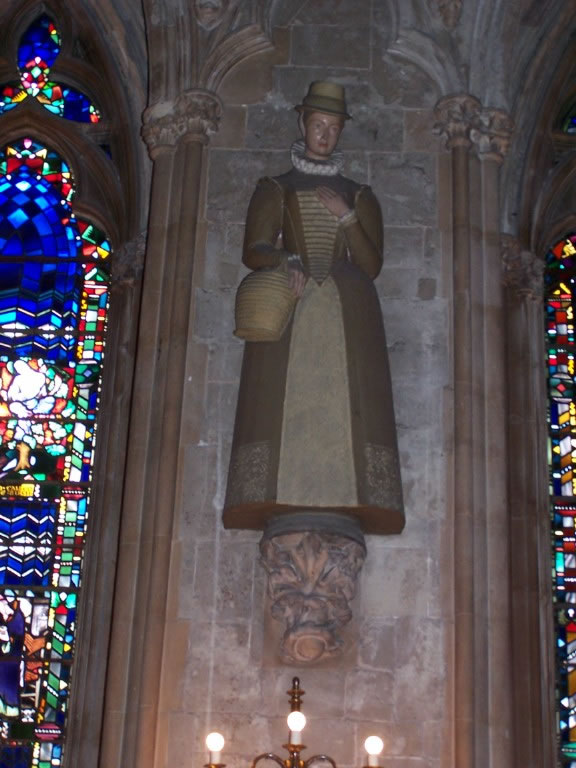
Saints Margaret Clitherow, Anne Line and Margaret Ward

We beseech Thee, O Lord our God, grant us to revere with unceasing devotion the glorious victories of Thy holy Martyrs Saints Margaret Clitherow, Anne Line and Margaret Ward; may we at least honor with our lowly homage those whose praises we cannot sing worthily.

St Margaret Clitherow.jpg
Saint Margaret Middleton was born in York in 1556, lived there all her life, and died there on 25 March 1586. At 15, she married a butcher, John Clitherow, and three years later became a Catholic. Imprisoned for her non-attendance at church, she taught herself to read and later ran a small school for her own and her neighbours' children. Her husband remained Protestant, but allowed her to hide priests in their house. In 1586, the secret hiding places were discovered, and Margaret was put on trial. She refused to plead, for which the punishment was being crushed to death.

St Ann Line.jpeg
Saint Anne Heigham was born at Dunmow (Essex) around 1565, and was hanged at Tyburn on 27 February 1601. In her teens, she became a Catholic and was disinherited, and in 1585 married Roger Line, also a disinherited convert, who was subsequently imprisoned then exiled for his faith, leaving her destitute. She taught and embroidered, and also kept house for priests. After a large number of people had been seen gathering at her house for Mass, she was arrested, tried and condemned to death.

St Margaret Ward.jpg
Saint Margaret Ward was born at Congleton (Cheshire), but entered into the service of a family in London. She was arrested after assisting a priest escape from prison, but refused under severe torture to reveal his hiding place or to renounce her faith. She was tried at the Old Bailey, and executed on this day in 1588. All three are remembered for their resourcefulness, for their loyalty, for their outstanding courage, and for the service they rendered the Church during dangerous times in aiding the ministry of priests.   (Liturgy Office, Bishops of England & Wales)

For more on these 3 English Martyrs see this entry.
In the Diocese of Bridgeport, those who prepare for the major seminary at Saint John Fisher Seminary, Stamford, call to mind the martyrdom of these women saints daily as their statues surround the altar.  May Saints Margaret, Anne and Margaret, pray for us!!!